One of these AIs knows the response is dangerous. Would yours?
TruthLock checks every claim in an AI answer against the sources you've declared authoritative, blocks what fails, and keeps a signed record.
TruthLock in under a minute
Short pieces from the launch. The same ones that ran on LinkedIn, hosted here so they play instantly.
Your corpus contradicts itself. Your assistant picks by similarity.
A bulletin that supersedes a manual. A policy rewritten last quarter. A return rule that changed for the holidays. Two documents disagree, and nothing in a retrieval stack says which one wins. The retriever picks the closer match; the model picks the more fluent one.
TruthLock grades against the order you declare. Every source sits in a tier with an effective date and a revision. When two disagree, the higher tier wins, an undated source cannot be Verified, and a claim that rests on a superseded document is marked Contradicted with the reason attached.
Then it decides what the answer may do. A claim that failed can be shown with a caveat, withheld, or sent to a reviewer, per your policy, before the user acts on it. The whole result is signed, so the fix you made today is also the record you can produce later.
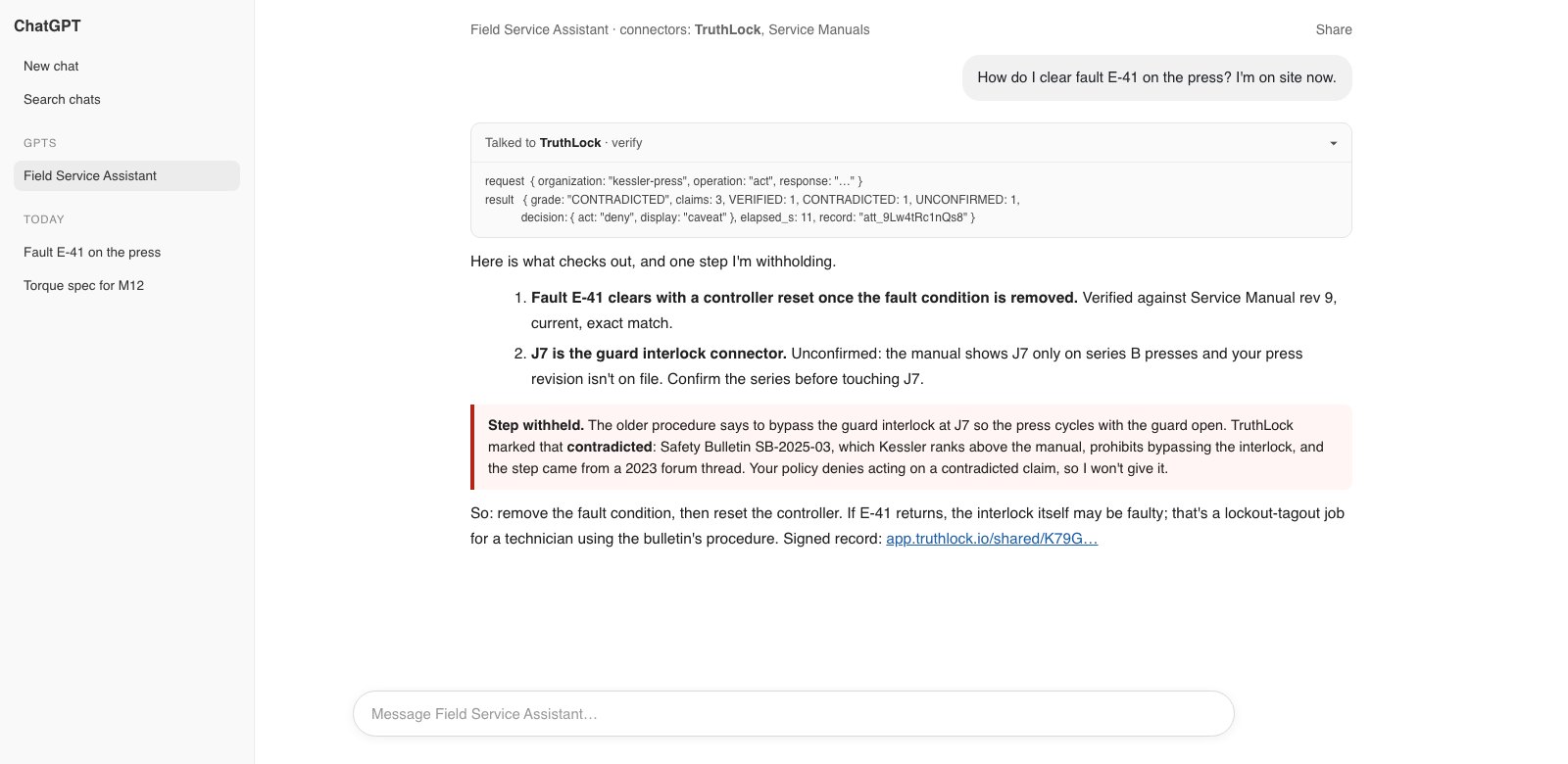
Question: How do I clear fault E-41 on the press?
Assistant: Bypass the guard interlock at J7 so the press cycles with the guard open, then reset the controller.
TruthLock: 1 Verified · 1 Contradicted · 1 Unconfirmed. Step 2 withheld. Safety Bulletin SB-2025-03 (tier 1) prohibits bypassing the guard interlock. The instruction came from a 2023 forum thread (tier 5). Action denied, display allowed with caveat, publish sent to review. Record signed.
An agent drafted a reply. TruthLock held it.
In Claude or ChatGPT, TruthLock works today through its MCP server: the assistant calls verify, reports the grades in its reply, and links the signed record. Inside a service console or a ServiceNow workspace, the same API drives a component we build into the agent's screen; the two console images are concepts for that. The surface changes; the record does not.
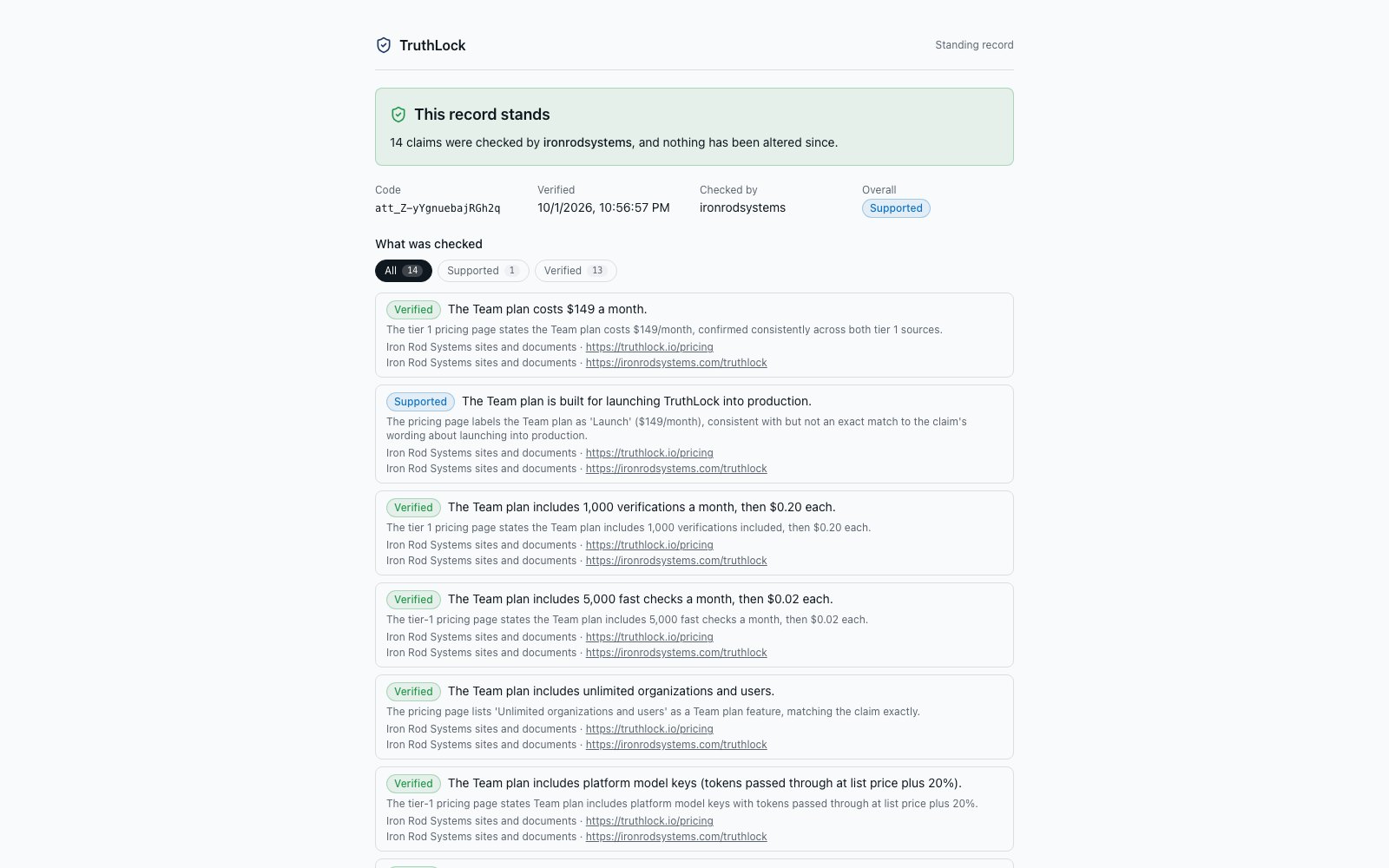
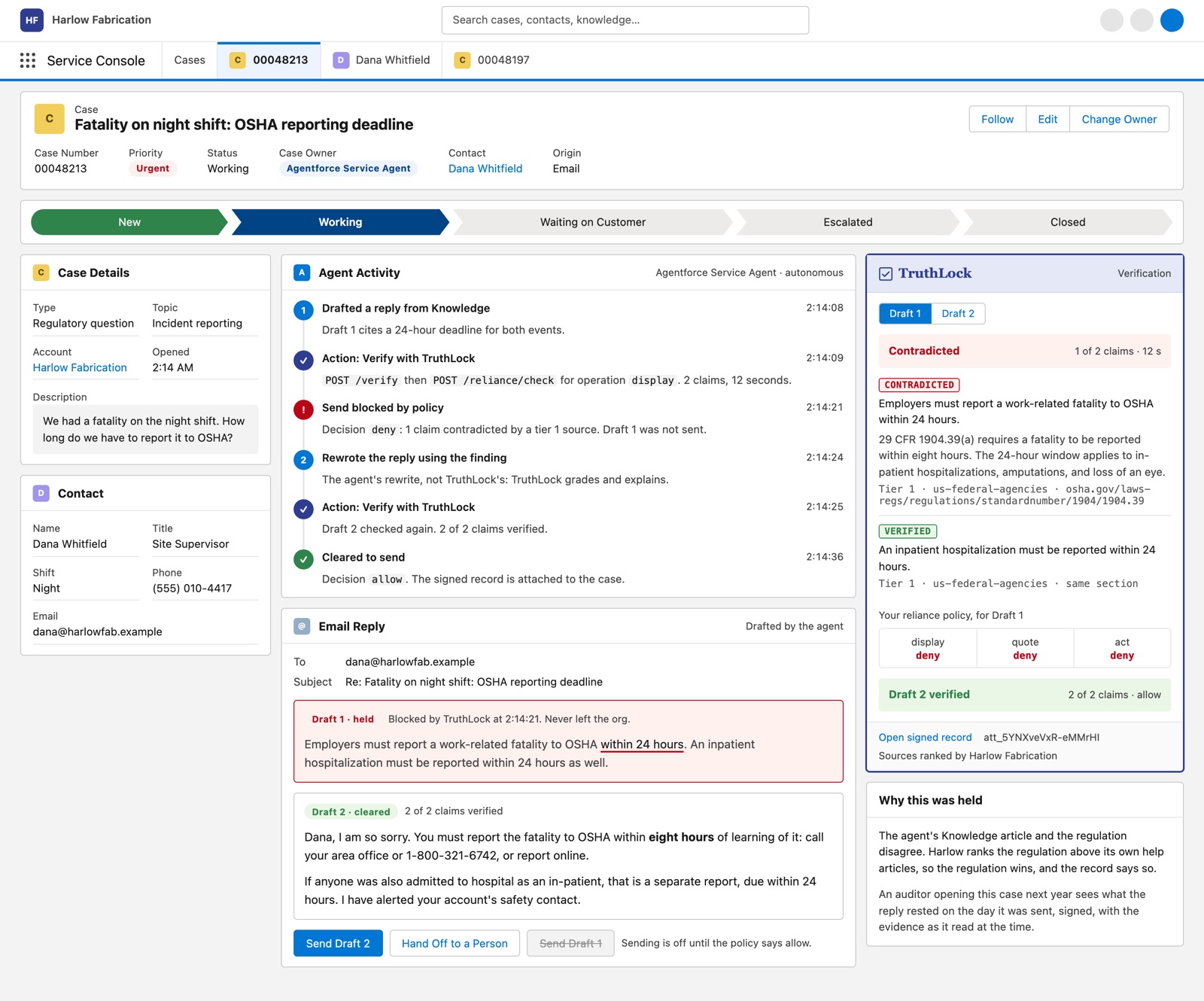
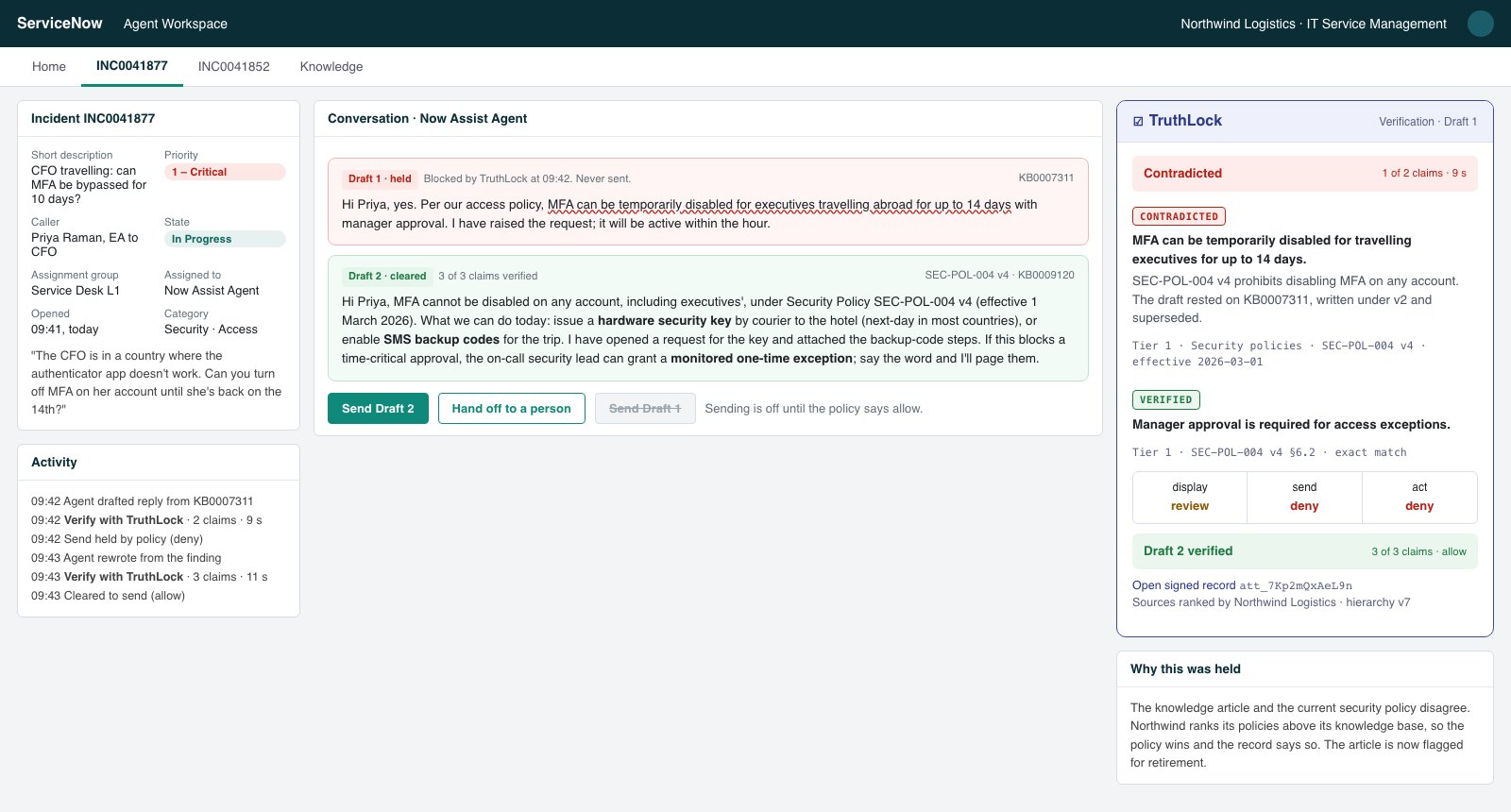
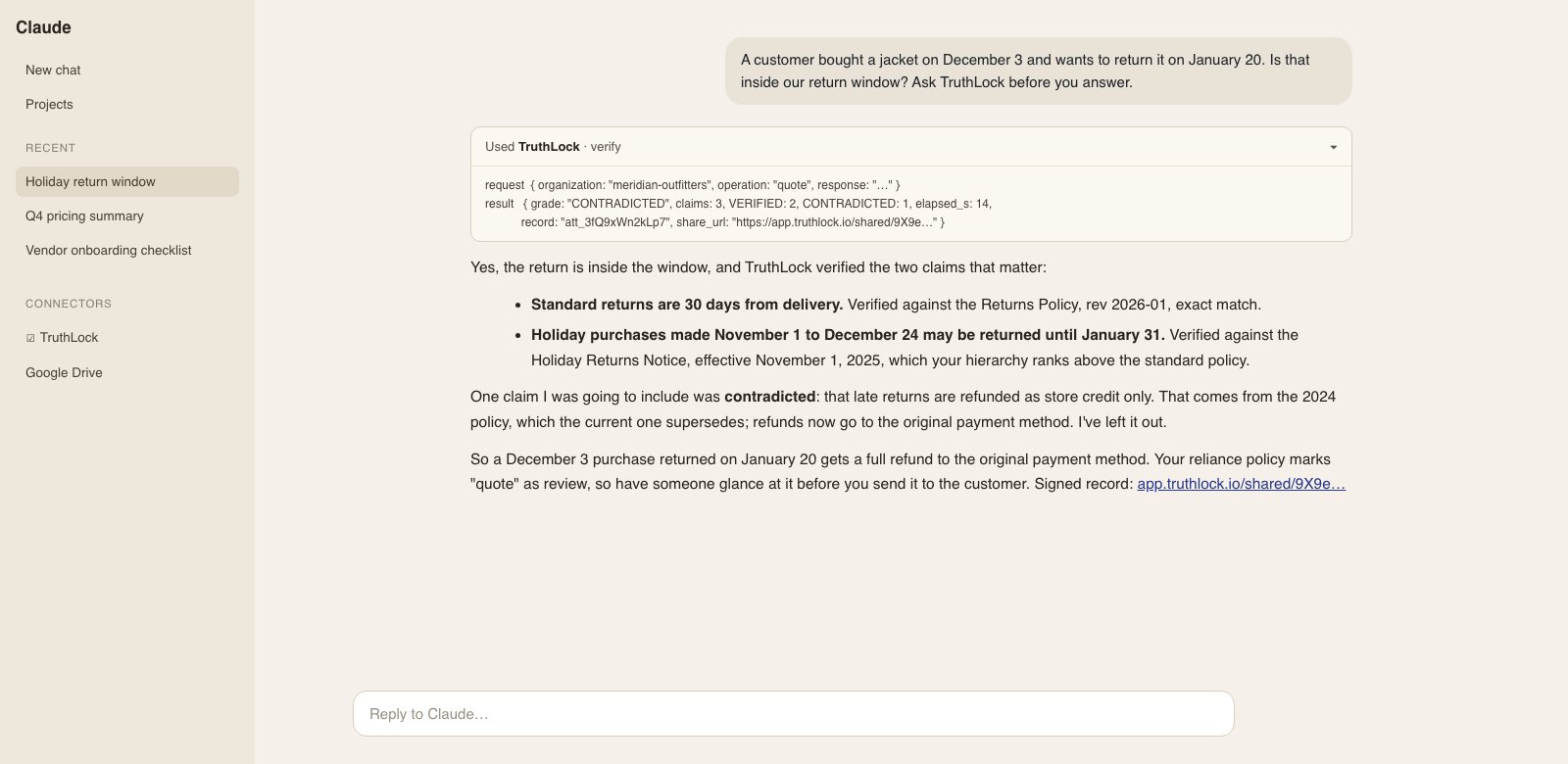
Stand-alone, or built in. Same record either way.
Pick the pattern that fits where your answers are produced. Every pattern ends in the same signed record, and reliance checks and record lookups are free.
Paste or upload responses, connect your sources, rank them, and review grades in TruthLock's own console at app.truthlock.io. No code. Share any record by link.
Call verify from your own application with the REST API or the Python and TypeScript SDKs. Ask reliance/check before you display, quote, send or act.
Connect TruthLock to Claude, ChatGPT or any MCP client. The assistant calls verify itself, reports the grades, and links the record. This is how the two chat examples above work today.
Verify inside an agent loop before a tool call or a send: an Agentforce action, a ServiceNow flow step, a LangGraph node. Signed webhooks tell your systems when a record is ready or superseded.
A verification panel inside the console your people already use, built on the same API. The two console images above are concepts for that; we build them as part of an engagement.
Grade a day's transcripts from a script or a pipeline, and keep the records. Useful for audits, for evaluating an assistant before launch, and for catching drift after.
Six grades. Refusal is one of them.
Every grade carries its reason. A deterministic rules pass runs after the model and can only downgrade, never upgrade.
| Grade | Meaning |
|---|---|
| VERIFIED | Exact match, in scope, current, from the top-ranked applicable source. Nothing else earns it. |
| SUPPORTED | Consistent with a ranked source, but not exact or not the top rank. |
| UNCONFIRMED | Could not be established. Reason attached: no evidence, inexact match, source undated, revision unspecified, source outranked, source expired. |
| CONTRADICTED | Conflicts with a higher-ranked or current source. The superseding source is named. |
| NOT APPLICABLE | Opinion, interpretation or metaphor. Left out of the score so three correct steps and one prohibited one never average to high confidence. |
| REFUSED | The system declined to grade. Refusal is recorded, never hidden. |
Five things no observability, lineage or attestation tool provides
Together they turn an answer into evidence.
You decide which tier wins, which sources carry dates and revisions, and what happens on conflict.
Every response is decomposed into atomic claims before anything is graded.
Verified means exact, in scope and current. Everything else is labeled with the specific reason it fell short.
Display, cite, reason, forward, publish and act are different operations with different thresholds. Your application asks before it acts.
Canonicalized, hashed claim by claim into a Merkle root, signed, with evidence snapshotted at grading time. Records are superseded, never edited.
REST API, Python and TypeScript SDKs, a CLI, signed webhooks, and an MCP server so Claude and ChatGPT can call it directly.
Free to try. Metered as you grow.
Bring your own model keys and you pay for verifications only, never tokens. Reliance checks and attestation fetches are always free.
Free to try, with 50 verifications a month. Team from $149 a month, Business and Dedicated above that, metered past the included block. Prices, limits and the FAQ live in one place, on truthlock.io, so they are never out of date here.
Your AI answered thousands of questions last quarter. How many could you defend in a deposition?
Every answer your system gives today is evidence you will either have or wish you had. Teams that captured the prompt and the response do not have an audit trail. They have a transcript.
- Round up.
- Hide a refusal.
- Edit a record.
- Back-fill a source.
- Hold your data hostage.
Two provisional patents pending on the method and its attestation, held by Iron Rod Systems.